Books
Veletsianos, G. (2020). Learning Online: The Student Experience. Baltimore, MD: Johns Hopkins University Press.
Veletsianos, G. (2016). Social Media in Academia: Networked Scholars. New York, NY: Routledge.
Edited Books
(2022). Feminist Critical Digital Pedagogy: An Open Book. Provo, UT: EdTech Books.
Veletsianos, G. (2016). Emergence and Innovation in Digital Learning: Foundations and Applications. Edmonton, AB: Athabasca University Press.
Veletsianos, G. (2013). Learner Experiences with MOOCs and Open Online Learning. Madison, WI: Hybrid Pedagogy Press.
Veletsianos, G. (2010). Emerging Technologies in Distance Education. Edmonton, AB: Athabasca University Press.
Journal Articles & Book Chapters
Veletsianos, G. & Houlden, S. (2026). What youth imagine, what AI reproduces: Sociotechnical imaginaries in education futures research. Educação On-line, 21(49), e2621IA11. https://doi.org/10.36556/eol.v21i1.2148.
Veletsianos, G. & Houlden, S. (2026). Imagination as contested terrain: Elite futurism, disimagination politics, and education futures. Futures, 181. https://doi.org/10.1016/j.futures.2026.103839
Kendeou, P., Veletsianos, G., & Whetung, C. (2026) Reflexivity For AI-Augmented Research. Nature Communications Psychology, 4(125). https://doi.org/10.1038/s44271-026-00527-3
Houlden, S., & Veletsianos, G. (2026). Midwifing liberatory education futures with education fiction: On the need to cultivate decolonial imagination. Learning, Media, and Technology, 51(3), 549-562. https://doi.org/10.1080/17439884.2025.2572628
Veletsianos, G. (2025). Simple Checklists to Verify the Accuracy of AI-Generated Research Summaries. Tech Trends, 69, 1121-1122. Final version available at https://doi.org/10.1007/s11528-025-01127-4 but here is a public pre-print.
Rosenberg, J., Veletsianos, G., Romero-Hall, E., & Allen, E. (in press). The Accessibility of Published Research in AERA Journals, 2010-2022. Teachers College Record.
Heinsfeld, B.D., & Veletsianos, G. (in press). The Language on GenAI: A Critical Exploration of Personification Metaphors in UNESCO’s Guidance for Generative AI in Education and Research. Journal of Interactive Media in Education.
Veletsianos, G., Arabadzhy, G., Athilat, V., Bartucz, J., Dogra, S., Fredrickson, N. R., Goeke, M., Jeon, S., Urena, M., Jandrić, P., Green, B. J., & Jackson, L. (in press). Postdigital peer review: A vulnerable space between freedom and responsibility. Postdigital Science and Education. https://doi.org/10.1007/s42438-025-00604-6
Kimmons, R., Veletsianos, G., & Trust, T. (2025). Judicious AI Use to Improve Existing OER. The AI + Open Education Initiative.
Veletsianos, G. (2025). Professional Learning for Teachers and Educators across the Commonwealth: Designing Online Assessments. In Orange, B. et al. (Eds), Innovative Models and Practices in Teacher Development: Case Studies from the Commonwealth (pp. 112-122). Commonwealth of Learning. https://doi.org/10.56059/11599/5700
Veletsianos, G. & Houlden, S. (2024). Youth perspectives on three speculative futures for higher education. Journal of Open, Distance, and Digital Education, 1(1), 1-17. https://doi.org/10.25619/gv5shv76
Veletsianos, G., Houlden, S., & Johnson, N. (2024). Is Artificial Intelligence in education an object or a subject? Evidence from a story completion exercise on learner-AI interactions. Tech Trends, 68, 411-422. The final version is available at https://doi.org/10.1007/s11528-024-00942-5 but here is a public pre-print.
Veletsianos, G., Johnson, N., & Houlden, S. (2024). How do Canadian Faculty Members Imagine Future Teaching and Learning Modalities? Educational Technology Research & Development, 72(3), 1851 – 1868. https://doi.org/10.1007/s11423-024-10350-4 (here is a public pre-print).
Houlden, S., & Veletsianos, G. (2024). Radical Imagination for a New Social Contract for Education. Prospects, 54, 499–506. https://doi.org/10.1007/s11125-024-09678-9
Veletsianos, G., & Houlden, S. (2024). On the “university of the future”: A critical analysis of cohort-based course platform Maven. Learning, Media, & Technology, 49(3), 401-413. https://doi.org/10.1080/17439884.2023.2164862 or pre-print (pdf).
Gosse, C., O’Meara, V., Hodson, J., & Veletsianos, G. (in press). Too rigid, too big, too slow: Institutional readiness to protect and support faculty from technology facilitated violence and abuse. Higher Education. https://doi.org/10.1007/s10734-023-01043-7 or preprint (pdf).
Veletsianos, G., & Johnson, N. (2023). Canadian Faculty Members’ Hopes and Anxieties about the Near-future of Higher Education. Canadian Journal of Learning and Technology, 48(3), 1-23. https://cjlt.ca/index.php/cjlt/article/view/28319
Houlden, S. & Veletsianos, G. (2022). Impossible dreaming: On speculative education fiction and hopeful learning futures. Postdigital Science and Education. https://doi.org/10.1007/s42438-022-00348-7 or preprint (pdf).
Veletsianos, G., Houlden, S., Hodson, J., Thompson, & C., Reid, D. (2022). An evaluation of a microlearning intervention to limit COVID-19 online misinformation. Journal of Formative Design in Learning, 6, 13-24. https://doi.org/10.1007%2Fs41686-022-00067-z
Veletsianos, G., Houlden, S., Reid, D., Hodson, J., Thompson, C. (2022). Design Principles for an Educational Intervention into Online Vaccine Misinformation. Tech Trends, 66(5), 748-759.
Houlden, S., & Veletsianos, G. (2022). A synthesis of surveys examining the impacts of COVID-19 and emergency remote learning on students in Canada. Journal of Computing in Higher Education, 34, 820–843. Preprint (pdf) or https://doi.org/10.1007/s12528-022-09323-4
Moore, S., Veletsianos, G., & Barbour, M. (2022). A synthesis of research on mental health and remote learning: How pandemic grief haunts claims of causality. The Open/Technology in Education, Society, and Scholarship Association Journal, 2(1), 1-19. https://doi.org/10.18357/otessaj.2022.1.1.36
Veletsianos, G., Childs, E., Cox, R., Cordua-von Specht , I., Grundy, S., Hughes, J., Karleen, D., & Wilson, A. (2022). Person in environment: Ecological aspects of online and distance learning. Distance Education, 43(2), 318-324. Preprint (pdf) or https://doi.org/10.1080/01587919.2022.2064827
Johnson, N., Veletsianos, G., Reitzik, O., & VanLeeuwen, C. (2022). Faculty Perceptions of Online Education and Technology Use Over Time: A Secondary Analysis of the Annual Survey of Faculty Attitudes on Technology from 2013 to 2019. Online Learning, 26(3). http://dx.doi.org/10.24059/olj.v26i3.2824.
Belikov, O., VanLeeuwen, C., Veletsianos, G., Johnson, N., Torcivia, P. (2021). Professional and personal impacts experienced by faculty stemming from the intersection of the COVID-19 pandemic and racial tensions. Journal of Interactive Media in Education, 1, p. 8. http://doi.org/10.5334/jime.647
Veletsianos, G., VanLeeuwen, C.A., Belikov, O., & Johnson, N. (2021). An Analysis of Digital education in Canada 2017-2019. The International Review of Research in Open and Distributed Learning. 22(2), 102-117. http://www.irrodl.org/index.php/irrodl/article/view/5108/5501
VanLeeuwen, C.A., Veletsianos, G., Belikov, O. Johnson, N. (2021). Never-ending repetitiveness, sadness, loss, and “juggling with a blindfold on:” Lived experiences of Canadian college and university faculty members during the COVID-19 pandemic. British Journal of Educational Technology, 52(4), 1306-1322. http://doi.org/10.1111/bjet.13065 or author’s pre-print copy.
Gosse, C., Veletsianos, G., Hodson, J., Houlden, S., Dousay, T., Lowenthal, P., Hall, N.C. (in press). The Hidden Costs of Connectivity: Nature and Effects of Scholars’ Online Harassment. Learning, Media, & Technology, xx-xx. https://doi.org/10.1080/17439884.2021.1878218 or author’s copy.
Kimmons, R., & Veletsianos, G. (2021). Proctoring Software in Higher Ed: Prevalence and Patterns. Educause Review, https://er.educause.edu/articles/2021/2/proctoring-software-in-higher-ed-prevalence-and-patterns.
Veletsianos, G., Kimmons, R. Larsen, R., & Rogers, J. (2021). Flexibility, Time, Gender, and Online Learning Completion. Distance Education, 42(1), 22-36. https://doi.org/10.1080/01587919.2020.1869523 or author’s pre-print copy.
Houlden, S., & Veletsianos, G. (2021). The Problem with Flexible Learning: Neoliberalism, Freedom, and Learner Subjectivities. Learning, Media, & Technology, 46(2), 144-155. https://doi.org/10.1080/17439884.2020.1833920 or author’s pre-print copy.
Veletsianos, G., & Houlden, S. (2020). Radical Flexibility and Relationality as Responses to Education in Times of Crisis. Postdigital Science and Education, 2(3), 849-862. https://doi.org/10.1007/s42438-020-00196-3
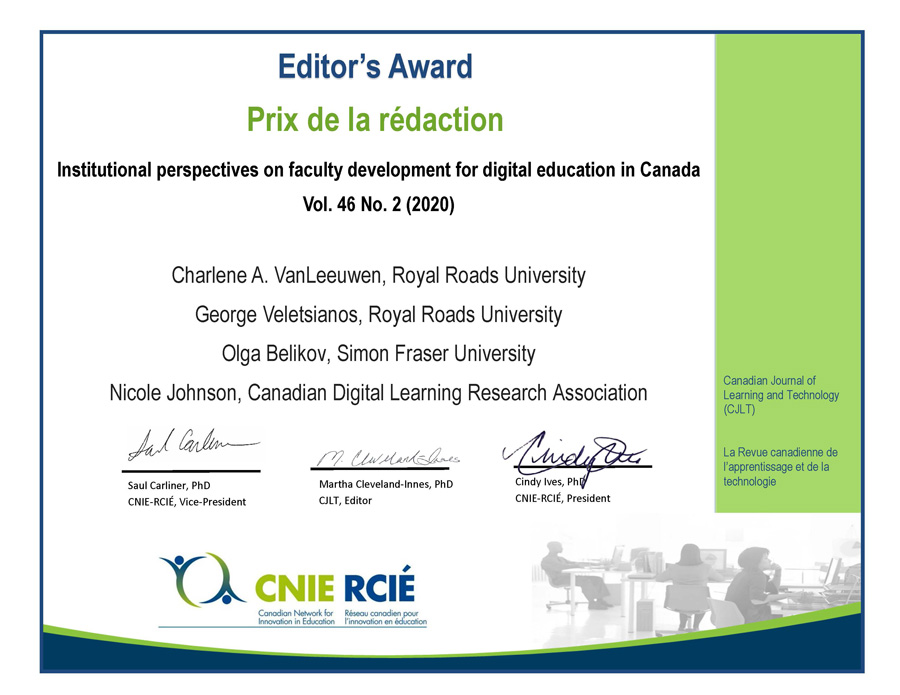
VanLeeuwen, C.A., Veletsianos, G., Belikov, O. , & Johnson, N. (2020). Institutional perspectives on faculty development for digital education in Canada. The Canadian Journal of Learning and Technology, 46(2), 1-20. https://www.cjlt.ca/index.php/cjlt/article/view/27944 *Canadian Network for Innovation Editor’s Award
Veletsianos, G. (2020). Open Educational Resources: Expanding Equity or Reflecting and Furthering Inequities? Educational Technology Research & Development
Veletsianos, G. (2020). How should we respond to the life-altering crises that education is facing? Distance Education, 41(4), 1-3. https://doi.org/10.1080/01587919.2020.1825066
Johnson, N., Veletsianos, G., Seaman, J. (2020). U.S. Faculty and Administrators’ Experiences and Approaches in the Early Weeks of the COVID-19 Pandemic. Online Learning Journal, 24(2), 6-21. http://dx.doi.org/10.24059/olj.v24i2.2285
Childs, E., Axe. J., Veletsianos, G., & Webster, K. (2020). Fostering Openness Within a higher education institution: tensions, opportunities, and a work in progress. In Prinsloo, P. & Conrad D. (Eds), Open(ing) Education (pp. 345-363). Brill | Sense Publishers. http://dx.doi.org/10.25316/IR-14930
Veletsianos, G. & Houlden, S., (2019). Flexible Learning Over the Last 40 Years of Distance Education. Distance Education, 40(4), 454-468.
Veletsianos, G., Johnson, N., Belikov, O. (2019). Academics’ Social Media Use Over Time is Associated with Individual, Relational, Cultural, and Political Factors. British Journal of Educational Technology, 50(4), 1713-1728.
Houlden, S., & Veletsianos, G. (2019). A Posthumanist Critique of Flexible Online Learning and its “Anytime Anyplace” Claims. British Journal of Educational Technology, 50(3), 1005-1018.
Veletsianos, G., Houlden, S., Hodson, J., Gosse, C. (2018). Women Scholars’ Experiences with Online Harassment and Abuse: Self-protection, Resistance, Acceptance, and Self-Blame. New Media & Society, 20(12), 4689-4708.
Hodson, J., Gosse, C., Veletsianos, G., Houlden, S. (2018). I Get By With a Little Help From My Friends: The Ecological Model and Support for Women Scholars Experiencing Online Harassment. First Monday, 23(8). doi: https://doi.org/10.5210/fm.v23i8.9136
Veletsianos, G., Kimmons, R., Belikov, O., Johnson, N. (2018). Scholars’ Temporal Participation on, Temporary Disengagement from, and Return to Twitter. First Monday, 23(11). http://dx.doi.org/10.5210/fm.v23i11.8346
Kimmons, R., & Veletsianos, G. (2018). Public Internet Data Mining Methods in Instructional Design, Educational Technology, and Online Learning Research. Tech Trends, 62(5), 492-500.
Veletsianos, G., Kimmons, R., Larsen, R., Dousay, T., & Lowenthal, P. (2018). Public Comment Sentiment on Educational Videos: Understanding the Effects of Presenter Gender, Video Format, Threading, and Moderation on YouTube TED Talk Comments. PLOS ONE 13(6): e0197331. https://doi.org/10.1371/journal.pone.0197331
Barker, J., Jeffery, K., Jhangiani, R., & Veletsianos, G. (2018). Eight Patterns of Open Textbook Adoption in British Columbia. The International Review of Research in Open and Distributed Learning, 19(3).
Paskevicius, M., Veletsianos, G., & Kimmons, R. (2018). Content is King: An analysis of how the Twitter discourse surrounding open education unfolded from 2009-2016. The International Review of Research in Open and Distributed Learning, 19(1).
Romero-Hall, E., Kimmons, R., & Veletsianos, G. (2018). Social Media Use by Instructional Design Departments. Australasian Journal of Educational Technology, 38(5).
Veletsianos, G., & Shaw, A. (2018). Scholars in an Increasingly Open and Digital World: Imagined Audiences and their Impact on Scholars’ Online Participation. Learning, Media, & Technology, 43(1), 17-30.
Veletsianos, G. (2017). Three Cases of Hashtags Used as Learning and Professional Development Environments. Tech Trends, 61(3), 284-292.
Veletsianos, G., Kimmons, R., Shaw, A., Pasquini, L. & Woodward, S. (2017). Selective Openness, Broadcasting, Branding, and Promoting: Twitter Use in Canada’s Public Universities. Educational Media International, 54(1), 1-19.
Veletsianos, G. (2017). Toward a Generalizable Understanding of Twitter and Social Media Use Across MOOCs: Who Participates on MOOC Hashtags and In What Ways? Journal of Computing in Higher Education, 29(1), 65-80.
Veletsianos, G., & Moe, R. (2017). The Rise of Educational Technology as a Sociocultural and Ideological Phenomenon. Educause Review. Retrieved on Apr 10, 2017 from http://er.educause.edu/articles/2017/4/the-rise-of-educational-technology-as-a-sociocultural-and-ideological-phenomenon
Kimmons, R., Veletsianos, G., & Woodward, S. (2016). Institutional Uses of Twitter in Higher Education. Innovative Higher Education, 42(2), 97-111.
Veletsianos, G. & Stewart, B. (2016). Scholars’ open practices: Selective and intentional self-disclosures and the reasons behind them. Social Media + Society, 2(3). doi: 10.1177/2056305116664222
Veletsianos, G., Reich, J., & Pasquini, L. (2016). The Life Between Big Data Log Events: Learners’ Strategies to Overcome Challenges in MOOCs? AERA Open, 2(3).
Kimmons, R. & Veletsianos, G. (2016 ). Education Scholars’ Evolving Uses of Twitter as a Conference Backchannel and Social Commentary Platform. British Journal of Educational Technology, 47(3), 445—464.
Veletsianos, G. & Shepherdson, P. (2016). A Systematic Analysis And Synthesis of the Empirical MOOC Literature Published in 2013-2015. The International Review of Research in Open and Distributed Learning, 17(2).
Veletsianos, G. (2016).Digital Learning Environments. In Rushby, N. & Surry D. (Eds) Handbook of Learning Technologies (pp. 242-260). Wiley.
Veletsianos, G., & Kimmons, R. (2016). Scholars in an Increasingly Digital and Open World: How do Education Professors and Students use Twitter? The Internet and Higher Education, 30, 1-10.
Veletsianos, G., Beth, B., Lin, C., & Russell, G. (2016). Design Principles for Thriving in Our Digital World, a High School Computer Science Course. Journal of Educational Computing Research, 54(4), 443-461.
Kimmons, R., & Veletsianos, G. (2015). Teacher Professionalization in the Age of Social Networking Sites: Identifying Major Tensions and Dilemmas. Learning, Media, and Technology, 40(4), 480-501.
Veletsianos, G. (2015). A case study of scholars’ open and sharing practices. Open Praxis, 7(3), 199-209.
Veletsianos, G. & Shepherdson, P. (2015). Who studies MOOCs? Interdisciplinarity in MOOC research and its changes over time. The International Review of Research in Open and Distributed Learning. http://www.irrodl.org/index.php/irrodl/article/view/2202/3348
Veletsianos, G., Miller, B., Eitel, K., Eitel, J., Hougham, J., & Hansen, D. (2015). Lessons Learned from the Design and Development of Technology-Enhanced Outdoor Learning Experiences. Tech Trends, 59(4), 78-86.
Veletsianos, G., Collier, A., & Schneider, E. (2015). Digging Deeper into Learners’ Experiences in MOOCs: Participation in social networks outside of MOOCs, Notetaking, and contexts surrounding content consumption. British Journal of Educational Technology 46(3), 570-587.
Kimmons, R., & Veletsianos, G. (2014). The Fragmented Educator 2.0: Social Networking Sites. Acceptable Identity Fragments, and the Identity Constellation. Computers & Education, 72, 292-301.
Ford, K., Veletsianos, G., & Resta, P. (2014). The Structure and Characteristics of #PhDChat, an Emergent Online Social Network. Journal Of Interactive Media In Education, 18(1). Retrieved April 16, 2014, from http://www-jime.open.ac.uk/jime/article/view/2014-08
Veletsianos, G. (2013). Open Practices and Identity: Evidence from Researchers and Educators’ Social Media Participation. British Journal of Educational Technology, 44(3), 639-651.
- Translated to Danish and reprinted as: Veletsianos, G (2014). Abne Praksisser Og Identitet – evidens fra forskeres og underviseres deltagelse i sociale medier. Kognition & Paedagogik, 92 (24), 12-30.
Veletsianos, G. & Russell, G. (2014). Pedagogical Agents. In Spector, M., Merrill, D., Elen, J., & Bishop, MJ (Eds.), Handbook of Research on Educational Communications and Technology, 4th Edition (pp. 759-769). Springer Academic.
Veletsianos, G. & Russell, G. (2013). What do learners and pedagogical agents discuss when given opportunities for open-ended dialogue? Journal of Educational Computing Research, 48(3), 381-401.
Veletsianos, G., Kimmons, R., & French, K. (2013). Instructor experiences with a social networking site in a higher education setting: Expectations, Frustrations, Appropriation, and Compartmentalization. Educational Technology, Research and Development, 61(2), 255-278.
Veletsianos, G. & Kimmons, R. (2013). Scholars and Faculty Members Lived Experiences in Online Social Networks. The Internet and Higher Education, 16(1), 43-50.
Veletsianos, G., Doering, A, & Henrickson, J. (2012). Field-based professional development of teachers engaged in distance education: experiences from the Arctic. Distance Education, 33(1), 45-59.
Veletsianos, G. & Kimmons, R. (2012). Assumptions and Challenges of Open Scholarship. The International Review Of Research In Open And Distance Learning,13(4), 166-189. [HTML access or PDF access]
Veletsianos, G. (2012). Higher Education Scholars’ Participation and Practices on Twitter. Journal of Computer Assisted Learning, 28(4), 336-349.
Veletsianos, G. (2012). Adventure Learning. In Seel, N. (Ed.), Encyclopedia of the Sciences of Learning (pp. 157-160). Springer Academic.
Veletsianos, G. & Navarrete, C. (2012). Online Social Networks as Formal Learning Environments: Learner Experiences and Activities. The International Review Of Research In Open And Distance Learning, 13(1), 144-166
Veletsianos, G. (2012). How do Learners Respond to Pedagogical Agents that Deliver Social-oriented Non-task Messages? Impact on Student Learning, Perceptions, and Experiences. Computers in Human Behavior, 28(1), 275-283.
Veletsianos, G. & Kimmons, R. (2012). Networked Participatory Scholarship: Emergent Techno-Cultural Pressures Toward Open and Digital Scholarship in Online Networks. Computers & Education, 58(2), 766-774.
Veletsianos, G. (2011). Designing Opportunities for Transformation with Emerging Technologies. Educational Technology, 51(2), 41-46.
Gulz, A., Haake, M., Silvervarg, A., Sjoden, B., & Veletsianos, G. (2011). Building a Social Conversational Pedagogical Agent: Design Challenges and Methodological Approaches. In Perez-Marin, D., & I. Pascual-Nieto (Eds.), Conversational Agents and Natural Language Interaction: Techniques and Effective Practices (pp. 128-155). IGI Global.
Veletsianos, G. (2010). A Definition of Emerging Technologies for Education. In G. Veletsianos (Ed.), Emerging Technologies in Distance Education (pp. 3-22). Athabasca University Press.
Veletsianos, G. (2010). A Small-Scale Adventure Learning Activity and its Implications for Higher Education Practice and Research. in education, 16(1).
Veletsianos, G. (2010). Contextually relevant pedagogical agents: Visual appearance, stereotypes, and first impressions and their impact on learning. Computers & Education, 55(2), 576-585.
Veletsianos, G., & Doering, A. (2010). Long-term student experiences in a hybrid, open-ended and problem based Adventure Learning program. Australasian Journal of Educational Technology, 26(2), 280-296. Retrieved April 14, 2010 from http://www.ascilite.org.au/ajet/ajet26/veletsianos.html
Veletsianos, G., Heller, R., Overmyer, S., & Procter, M. (2010). Conversational Agents in Virtual Worlds: Bridging Disciplines. British Journal of Educational Technology, 41(1), 123-140.
Veletsianos, G., & Kleanthous, I. (2009). A review of adventure learning. The International Review Of Research In Open And Distance Learning, 10(6), 84-105. Retrieved December 27, 2009, from http://www.irrodl.org/index.php/irrodl/article/view/755
Doering, A., Veletsianos, G., & Scharber, C., & Miller, C. (2009). Using the Technological, Pedagogical, And Content Knowledge Framework to Design Online Learning Environments and Professional Development. Journal of Educational Computing Research, 41(3), 319-346.
Doering, A., & Veletsianos, G. (2009). Teaching with Instructional Software. In M. D. Roblyer & A. Doering (Eds.), Integrating Educational Technology into Teaching (73-108). Upper Saddle River, NJ: Pearson Education.
Veletsianos, G., Miller, C., & Doering, A. (2009). EnALI: A Research and Design Framework for Virtual Characters and Pedagogical Agents. Journal of Educational Computing Research, 41(2), 171-194.
Veletsianos, G. (2009). The impact and implications of virtual character expressiveness on learning and agent-learner interactions. Journal of Computer Assisted Learning, 25(4), 345-357.
Doering, A., Scharber, C., Miller, C., & Veletsianos, G. (2009). GeoThentic: Designing and Assessing with Technological Pedagogical Content Knowledge. Contemporary Issues in Technology and Teacher Education, 9(3).
Veletsianos, G. & Eliadou, A. (2009). Conceptualizing the Use of Technology to Foster Peace via Adventure Learning. The Internet and Higher Education, 12, 63-70.
Doering, A., & Veletsianos, G. (2008). What lies beyond effectiveness and efficiency? Adventure Learning Design. The Internet and Higher Education, 11(3-4), 137-144.
Veletsianos, G., & Miller, C. (2008). Conversing with Pedagogical Agents: A Phenomenological Exploration of Interacting with Digital Entities. British Journal of Educational Technology, 39(6), 969-986.
Doering, A., Miller, C., & Veletsianos, G. (2008). Adventure Learning: Educational, social, and technological affordances for collaborative hybrid distance education. Quarterly Review of Distance Education, 9(3), 249-266.
Miller, C., Veletsianos, G., & Doering, A. (2008). Curriculum at forty below: A phenomenological inquiry of an educator explorer’s experiences with adventure learning in the Arctic. Distance Education, 29(3), 253-267.
Doering, A., & Veletsianos, G. (Fall 2008). Hybrid Online Education: Identifying Integration Models using Adventure Learning. Journal of Research on Technology in Education, 41(1), 101-119.
Doering, A., Lewis, C., Veletsianos, G., & Nichols, K. (2008). Preservice Teachers’ Perceptions of Instant Messaging in Two Educational Contexts. Journal of Computing in Teacher Education, 25(1), 45-52.
Veletsianos, G., Scharber, C., & Doering, A. (2008). When Sex, Drugs, and Violence Enter the Classroom: Conversations between Adolescent Social Studies Students and a Female Pedagogical Agent. Interacting with Computers, 20(3), 292-301.
Wilson, B., Parrish, P., & Veletsianos, G. (2008). Raising the bar for instructional outcomes: Towards transformative learning experiences. Educational Technology, 48(3), 39-44.
Doering, A., Veletsianos, G., & Yerasimou, T. (2008). Conversational Agents and their Longitudinal Affordances on Communication and Interaction. Journal of Interactive Learning Research, 19(2), 251-270.
Doering, A., & Veletsianos, G. (2007). An Investigation of the Use of Real-Time, Authentic Geospatial Data in the K-12 Classroom. Journal of Geography, Special Issue on Using Geospatial Data in Geographic Education, 106(6), 217-225.
Veletsianos, G. (2007). Cognitive and Affective Benefits of an Animated Pedagogical Agent: Considering Contextual Relevance and Aesthetics. Journal of Educational Computing Research, 36(4), 373-377.
Doering, A., Veletsianos, G., & Scharber, C. (2007). Coming of Age: Research and Pedagogy on Geospatial Technologies within K-12 Social Studies Education. In A. J. Milson, and Alibrandi, M. (Eds), Digital Geography: Geo-Spatial Technologies in the Social Studies Classroom (pp. 213-226). Charlotte, NC: Information Age Publishing.
Doering, A., & Veletsianos, G. (2007). Multi-Scaffolding Learning Environment: An Analysis of Scaffolding and Its Impact on Cognitive Load and Problem-Solving Ability. Journal of Educational Computing Research, 37(2), 107-129.
Hooper, S., Miller, C., Rose, S., & Veletsianos, G. (2007). The Effects of Digital Video Quality on Learner Comprehension in an American Sign Language Assessment Environment. Sign Language Studies, 8(1), 42-58.
Other
Veletsianos, G., & Vrasidas C. (2015). Contributions to the mosaic describing learners’ experiences with open online learning. Educational Media International, 52(2), 69-71.
13 Pingbacks